Multiple genes of small effect, whose risk promoting ability is conditioned
by other genes and risk factors: For this reason any positive studies
are reported.
See also:- The fox and the rabbits, environmental variables and population
genetics.1: Replication problems in association studies and the untapped
power of GWAS. ISRN
Neurology, 2011
and has been associated with young age at motherhood , failure
to initiate breast feeding Gagliardi
et al, 2010 , urinary incontinence, and male children Sylvén
et al, 2011
Higher Toxoplasma gondii immunoglobulin G titers in infected women
were related to anxiety and depression during pregnancy Groer
et al, 2011.
Depression has been associated with human T-cell lymphotropic virus(
HTLV-1) infection Stumpf
et al, 2008
Bornavirus infection or reactivation have been linked to depression
and other affective disorders Ferszt
et al, 1999
Bornavirus related symptomatology has been reported to be improved
after CSF filtration Bechter
et al, 2000
Seropositivity for influenza A, Influenza B and coronaviruses has
been associated with a history of mood disorders but not with the specific
diagnosis of unipolar or bipolar depression. Seropositivity for influenza
B was associated with a history of suicide attempts and a history of
psychotic symptoms Okusaga
et al, 2011 .
Depression has been observed in poliomyelitis survivors Kang
and Lin 2011
Nipah virus encephalitis has been associated with depression Ng
et al, 2004
Lyme disease (Borrelia infection) has ben aaaociated with depression
Kaplan
et al, 1999
Suicide attempts in recurrent mood disorders have been linked to T.Gondii
seropositivity Arling
et al, 2009
Sexually transmitted infections have been linked to depression Lee
et al, 2009
High salivary Lactobacillus counts have been associated with depressive
symptoms Anttila
et al, 1999
Depression has been associated with tooth loss in older men Anttila
et al, 2001
Antibodies to lipopolysaccharide of commensal bacteria (gram-negative
enterobacteria, Hafnia Alvei, Pseudomonas Aeruginosa, Morganella Morganii,
Pseudomonas Putida, Citrobacter Koseri, and Klebsielle Pneumoniae) have
been associated with depression (bacterial translocation and "leaky
gut") Maes
et al, 2012 See also "So depression is an inflammatory
disease, but where does the inflammation come from?" Berk
et al, 2013
Skin infections commonly associated with psychiatric disorders including
depression Gupta
et al, 2013
Meta-analysis showed statistically significant associations between
depression and infection with Borna disease virus, herpes simplex virus-1,
varicella zoster virus, Epstein-Barr virus, and Chlamydophila trachomatis
Wang
et al, 2014.
The microbiome in depression
The order Bacteroidales showed an overrepresentation , while the family
Lachnospiraceae showed an underrepresentation of Operational Taxonomic
Units associated with depression (faecal microbiome) Naseribafrouei
et al, 2014
Increased levels of Enterobacteriaceae and Alistipes but reduced
levels of Faecalibacterium in the faecal microbiome in major depression
Jiang
et al, 2015.
Lower Bifidobacterium and/or Lactobacillus counts more common in patients
with major depression disorders (faecal microbiome) Aizawa
et al, 2016
Social factors
It is generally accepted that "stress" and deregulation
of the hypothalamic pituitary adrenal axis are major contributory factor
to depressions Refs
: Stress can take many forms linked to depression and some non-exhaustive
condititions include:-
The many effects of stress are equally as diverse and are well described
in Wikipedia: StressChronic
stress This is a vast subject, not detailed here: Simple summaries
include:-
Psychoneuroimmunology
The immune-brain loop : inflammatory cytokines stimulate adrenocorticotropic
hormone (ACTH) and cortisol secretion (chemical stressors) while,
in turn, glucocorticoids suppress the synthesis of proinflammatory
cytokines.
Urban living environments associated with higher rates of prescription
for psychotropic medication for anxiety, depression and psychosis McKenzie
et al , 2013.
Depression is one of several comorbid conditions in schizophrenia
Buckley
et al, 2009
Higher incidences of depression, myocardial infarction, lung cancer,
diabetes and hip fracture have been reported in chronic obstructive
pulmonary disease Sode
et al, 2011
A bidirectional relationship may exist between type 2 diabetes and
depression: type 2 diabetes increases the risk for onset of major depression,
and a major depressive disorder increases risk of onset of type 2 diabetes,
reviewed inDucat
et al, 2014
Psychiatric problems including psychosis and depression are observed
in Cushing syndrome (associated with high cortisol) Hirsch
et al, 2000
Depression is relatively common in systemic lupus erythematosus Meszaros
et al, 2012
Childhood-adolescence obesity has been reported as risk factor for
adult depression Sanchez-Villegas
et al, 2013.
Comorbidity with accelerated atherosclerosis and early cardiovascular
disease Goldstein
et al, 2015
Dietary and environmental factors and drugs
Ecstasy use ( Methylenedioxymethamphetamine ) has been associated
with depression Matthews
and Bruno, 2010
Vitamin B12 or Holotranscobalamin deficiency has been linked with
depression Robinson
et al, 2011 coupled with high levels of homocysteine Almedia
et al, 2008
High total intakes of vitamins B-6 and B-12 may protect against
depresion in the elderly Skarupski
et al, 2010
Long-term treatment of poststroke survivors with folic acid, vitamin
B6, and B12 was associated with a reduction in major depression risk
Almeida
et al, 2010
Diethylstilbestrol use has been associated with depression in women
Kebir
and Krebs, 2011
Interferon alpha (used for hepatitis C treatment) is often associated
with depression .Galvão-de
Almeida et al, 2011
Childhood depression may be associated with future smoking Niemelä
et al, 2009
Low fish consumption has been associated with severely depressed mood
in men Li
et al, 2011
Serum cotinine levels ( an index of second hand smoke) has been associated
with major depressive disorder, generalized anxiety disorder, attention-deficit/hyperactivity
disorder, and conduct disorder Bandiera
et al, 2011
Pesticide use, particularly paraquat, has ben associated with depression
in farmers Kim
et al, 2013
Herbicide use has been associated with depression in agricultural
workers Weisskopf
et al, 2013
Population suicide rates have been linked to the distribution of coal-fired
electricity plants Spangler,
2013
higher urinary levels of manganese, tin, and phthalates including
mono-2-ethyl-5-carboxypentyl, mono-n-butyl, mono-isobutyl, and mono-benzyl
were associated with adult depression. Urinary polyaromatic hydrocarbons
including 2-hydroxyfluorene, 3-hydroxyfluorene, 9-hydroxyfluorene, 1-hydroxyphenanthrene,
2-hydroxyphenanthrene, 3-hydroxyphenanthrene, 1-hydroxypyrene, 1-hydroxynaphthalene
(1-naphthol), 2-hydroxynaphthalene (2-naphthol) and 4-hydroxyphenanthrene
were associated with depression Shiue
2015.
Long-term particulate matter (PM2.5) exposure increases the risk of
major depressive disorder Kim
et al, 2016
Comparative
toxicogenomics database: Bioinformatic predictions of environmental
toxins, drugs , endogenous compounds and others related to depression
Biochemistry and pathology
Loss of white matter intergrity in the limbic system and frontal cortex
related to demyelination Korgaonkar
et al, 2011
Grey matter loss in the limbic system and frontal cortex characterised
by synaptic poverty Bennett,
2011
Plasma levels of beta-amyloid (1-42) may predict late life depression
Blasko
et al, 2010
Depression associated with low high-density lipoprotein cholesterol
in women, but low low-density lipoprotein cholesterol in men Ancelin
et al, 2010
High plasma levels of lipoprotein a ( LPA ) have been reported in
depression Hamidifard
et al, 2009
Increased superoxide dismutase (SOD1) and catalase activity and malondialdehyde
levels in erythrocytes during depressive episodes (oxidative stress)
Galecki
et al, 2009
Multiple aberrations in inflammatory, oxidative and nitic oxide related
stress pathways Maes
et al, 2010
Lower levels of omega-3 polyunsaturated fatty acids in depressed patients
Baghai
et al, 2010
lower levels of eicosapentaenoic acid , docosahexaenoic acid ,
and total n-3 polyunsaturated fatty acids in patients with depression
Lin et al, 2010
Reduced expression of fatty acid synthesis genes in the frontal cortex
in depression McNamara
and Liu, 2011
Low levels of plasma tryptophan and induction of indoleamine 2,3-dioxygenase
indicative of infection/immune activation Maes,
2011
Plasma levels of kynurenine elevated in severe depression Sublette
et al, 2011 Modified ratios of kynureine to kynerenic acid have
been reported in depression and other psychiatric disorders Myint
, 2012
Suicidal patients display a distinct peripheral blood cytokine profile
compared to non-suicidal depressed patients (increased levels of IL-6
and TNF-alpha and decreased IL-2) Janelidze
et al, 2011
Plasma aldosterone levels have also been reported to be lower
in suicidal depression Hallberg
et al, 2011
Low levels of CSF S-adenosylmethionine have been reported in depression
Bottiglieri
et al, 1990
S-adenosylmethionine has been reported to possess antidepressant
effects Papakostas
, 2009
Depression and the immune system
Pro-inflammatory cytokines and lipopolysacharide ( a bacterial cell
wall component ) may induce depressive symptoms
Maes et al, 2008.
Depression is associated with a suppression of mitogen-induced lymphocyte
proliferation and with a reduction of natural killer kell activity activity
Irwin,
1999
Atopy (Immunoglobulin E related allergies) can be associated with
a greater risk for developing depression in women Timonen
et al, 2002
Depression and fatigue during chronic Interferon alpha treatment were
associated with alterations in the expression (OAS2) and transcriptional
control (CREB/ATF) of genes linked to behavioral disorders including
chronic fatigue syndrome and major depression, supporting an immune
contribution to these diseases Felger
et al, 2011.
An inflammatory signature (CAPRIN1, CLEC4A, KRT23, MLC1, PLSCR1, PROK2,
ZBTB16) in lipopolysaccharide stimulated blood Spijker
et al, 2010
Depression is characterized by IgM-related autoimmune responses directed
against a) neoepitopes that are normally not detected by the immune
system but that due to damage by oxidative and nitrosative stress have
become immunogenic; and b) anchorage epitopes, i.e. palmitic and myristic
acids, and S-farnesyl-L-cysteine
IgM levels directed against conjugated palmitic and myristic
acids, acetylcholine, S-farnesyl-L-cysteine; and the conjugated
NO adducts, NO-tyrosine, NO-phenylalanine, NO-aspartate, NO-histidine,
and NO-creatine increased in depression Maes
et al, 2011
Mainly serotonin (SSRI's) or varying combinations of serotonin/noradrenaline
/dopamine uptake blockers, and monoamine oxidase inhibitors (see
Wikipedia)
N-acetyl cysteine (glutathione precursor) has been used as a supplement
in bipolar depression Berk
et al, 2008
Supplementation with n-3 polyunsaturated fatty acids is effictive
in depression treatment in elderly female patients Rondanelli
et al, 2010
Major depression has been associated with height above sea-level (possibly
related to hypoxic stress) DelMastro
et al, 2011
Suicide peaks in the spring months were observed in a large Danish
study Postolache
et al, 2010
Seasonal affective disorder related to latitude (greater in the north
in Greenland ) Kegel
et al, 2009
Old age is a risk factor for depression and after dementia, is the
most common disease in the over 65 Orzechowska
et al. 2008
Television and total media exposure in adolescence are associated
with increased odds of depressive symptoms in young adulthood, especially
in young men Primak
et al, 2009.
Depressed patients show accelerated cellular aging as measured by
shorter telomere length Verhoeven
et al, 2013
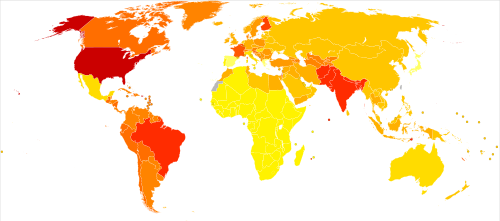
Unipolar depressive disorders world map from Wikimedia commons Lokal_Profil
Depression
news headlines provided courtesy of Medical News Today.
 Subscribe
in a reader
Subscribe
in a reader